How Can I Tell If My Rhode Island Red Chick Will Grow Up to Be Dark Red?
RIR chicks from the same hatch can be born in different shades — some lighter, others darker. Beak color in the first few days may indicate which birds will develop more intense adult plumage. Understand the genetic basis and how to use it in selection.
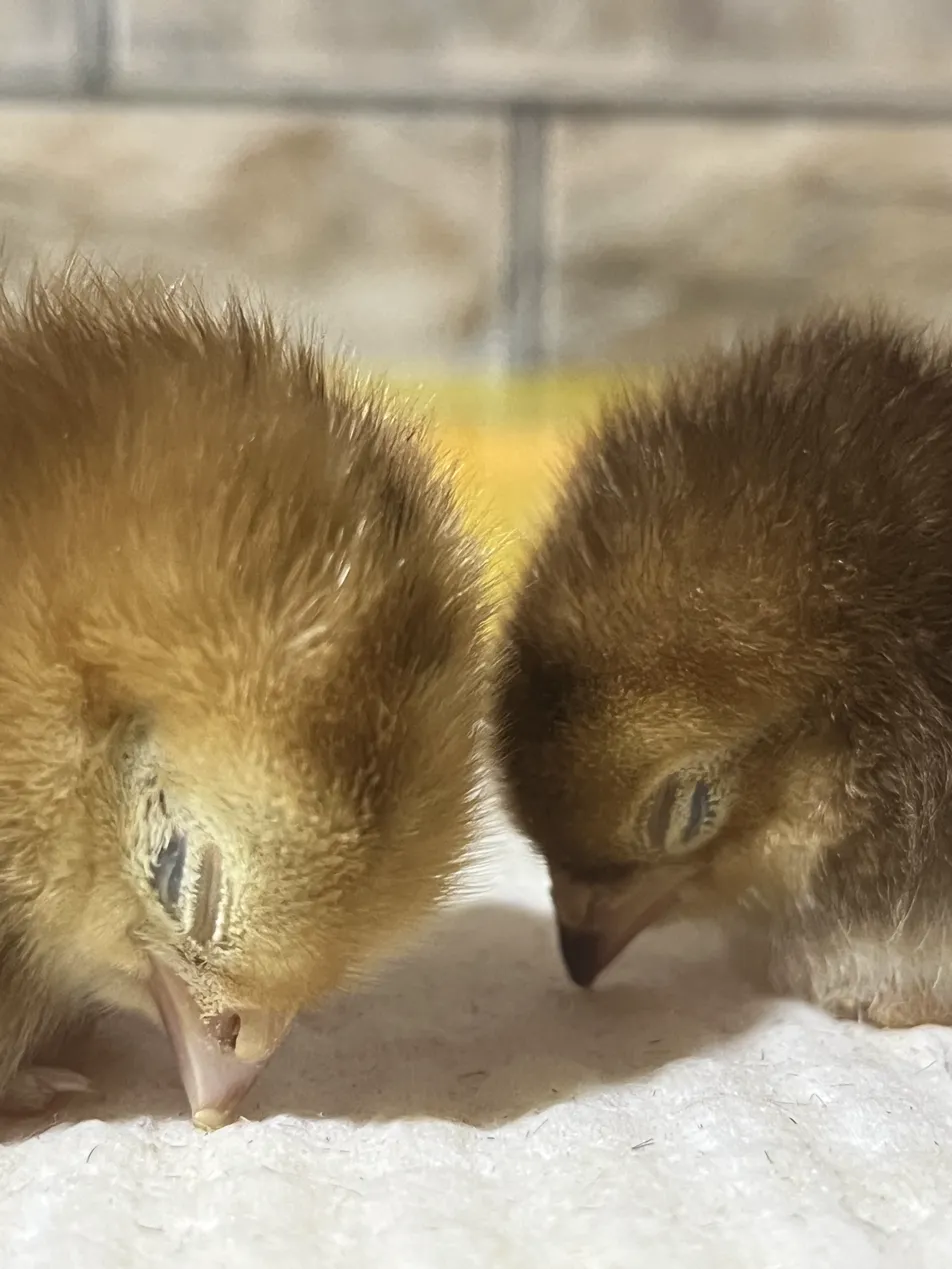
You look at a newly hatched batch of Rhode Island Red chicks and notice something you did not expect: they are not all the same. Some have darker, almost reddish down. Others are much lighter, tending toward yellow. Their beaks also range from dark grayish to light pinkish.
The natural question is: “which of these will be the most beautiful when it grows up?”
The short answer: a darker beak in the first few days tends to indicate more intense adult pigmentation. But understanding why changes the way you select birds.
Beak pigmentation in RIR: what genetics determines in the first few days
The adult plumage color of the Rhode Island Red depends mainly on pheomelanin — the pigment responsible for red, mahogany, and brown tones. Eumelanin (the dark/black pigment) also contributes, especially in the tail and flight feathers.
During the first days of life, melanin distribution is already visible in the beak, tarsi, and down. Chicks that accumulate more pigment in these structures soon after hatching tend to have a greater genetic capacity for melanin deposition — and this is correlated with adult plumage intensity.
Gallora data: At Lab Vivo, we record the beak color of each chick during the first 48 hours, together with an individual leg band and photograph. This simple data point, cross-referenced with the plumage assessment at 6 months, allows us to calibrate early selection using real evidence.
Why RIR chicks from the same hatch are born in different colors
Even when both parents are high-quality RIR, variation is expected. Pheomelanin intensity is polygenic — controlled by multiple genes, each contributing a small effect. Genes such as MC1R (melanocortin 1 receptor) and modifiers such as Mh (mahogany) influence the final result, but no single gene determines “dark red” or “light red.”
It is like height in humans: two tall parents can have children who differ somewhat in height. The genetic foundation is there, but the exact combination varies with each fertilization.
In addition to genetics, environmental factors during incubation — temperature, humidity, and egg position — may slightly influence pigment deposition in the down without changing the genotype.
How to use beak color in early RIR selection
Early selection based on beak pigmentation does not replace a complete assessment of adult plumage, but it works as a first filter that reduces the candidate group.
Practical protocol:
-
First 48 hours: observe and record the beak color of each chick (use an individual leg band or identification mark). Classify it into three ranges: dark, intermediate, light.
-
At 30 days: assess the emerging primary feathers. The relationship between a dark beak at hatch and feathers richer in pheomelanin may already begin to become visible.
-
At 6 months: perform the definitive evaluation. Compare it with the initial record. Over several generations, this cross-referencing reveals which early indicators are most reliable within your specific flock.
Gallora data: In our records, chicks with dark beaks (grade 3/3 on our internal scale) tended to develop adult plumage closer to the dark mahogany required by the APA Standard. This correlation is not absolute — it is a trend that becomes more statistically reliable as more data are collected.
What the APA Standard requires for RIR color
The American Standard of Perfection describes the ideal Rhode Island Red color as “rich, brilliant, dark red.” Washed-out or light tones, or excessive black on the surface, are penalized.
The beak should be “reddish horn.” Very light or yellowish beaks are considered a fault.
Therefore, early selection for a darker beak at hatch is aligned with the breed-standard objective: birds with greater pigment-deposition capacity tend to better meet the criteria for both adult plumage and beak color.
Limitations of early selection based on pigmentation
Not every dark-beaked chick will become an outstanding adult, and not every light-beaked chick should be discarded. Pigmentation is only one of many selection criteria — type, size, conformation, health, and productivity are equally important.
Early selection works best as an initial screening tool in larger batches, reducing the number of birds that need space and resources until definitive evaluation. In small batches (fewer than 20 chicks), the statistical value of the indicator is lower.
Data-driven early selection: the differentiator of a genetic program
The difference between “thinking a dark beak is better” and “knowing that the correlation is X% in your flock” is documentation. Without records, each generation starts from zero. With records — leg band, photograph, standardized assessment — knowledge accumulates and selection becomes more precise with every cycle.
That is exactly what we do at Gallora Lab Vivo: each chick is a data point that feeds future decisions. It is not expensive or complex technology. It is method.
Have questions about early selection in your RIR flock? Share them on Instagram @gallora.oficial — every field observation contributes to Brazilian poultry science.
This article is part of Gallora’s Open Science series, where we publish real observations from Lab Vivo with scientific rigor and accessible language.
If you want RIR genetics with lineage traceability from the egg, learn about our genetic programs
Author: Cleber Barcelos Costa — Founder, Gallora Precision Poultry Genetics. ORCID: 0009-0000-5172-9019
References:
- Smyth, J. R. Jr. (1990). Genetics of plumage, skin and eye pigmentation in chickens. In: Poultry Breeding and Genetics, R. D. Crawford (ed.), Elsevier, chap. 5.
- Kerje, S. et al. (2003). The Dominant white, Dun and Smoky color variants in chicken are associated with insertion/deletion polymorphisms in the PMEL17 gene. Genetics, 164, p. 1507–1518.
- Ling, M. K. et al. (2003). Association of feather colour with constitutively active melanocortin 1 receptors in chicken. Eur. J. Biochem., 270, p. 1441–1449.
- APA — American Poultry Association. The American Standard of Perfection — Rhode Island Red: color description.
How to cite:
COSTA, C. B. How can I tell if my Rhode Island Red chick will grow up to be dark red? Gallora Blog, Betim/MG, Apr. 7, 2026. Available at: https://gallora.com.br/blog/rir-pigmentacao-bico-selecao-precoce