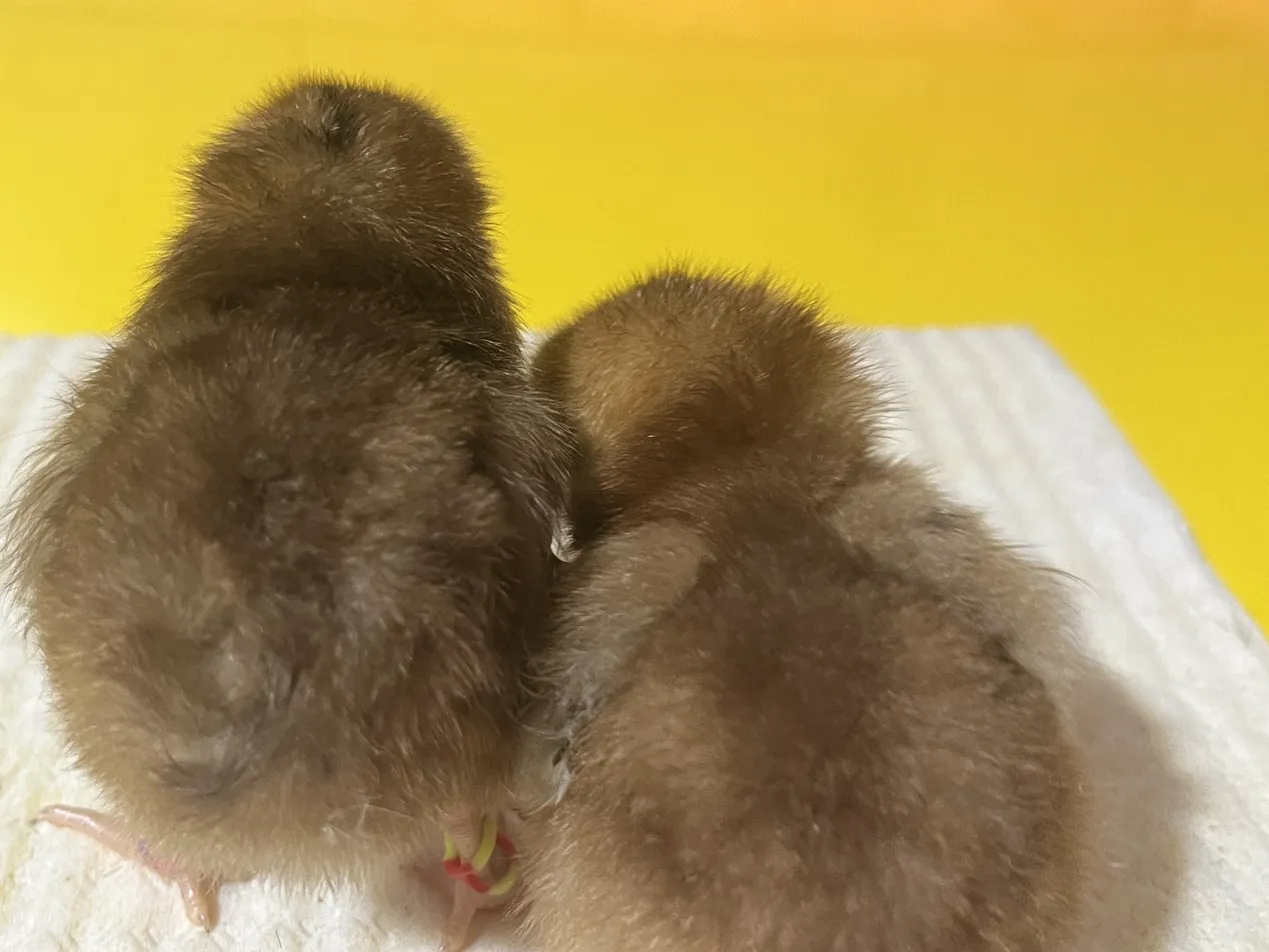
Why Do My Rhode Island Red Chicks Have a Light Belly and Dark Back?
RIR chicks with a dark back and light belly can worry breeders expecting a uniform red color. But this uneven color distribution is normal and reveals how melanin works.
The chick hatches and you notice: its back is dark, reddish-brown, but its belly is light — almost white or pale yellow. It looks wrong. It seems as if the red color “didn’t reach” the belly. It looks like a cross with another breed.
It isn’t. It is a normal physiological pattern of melanin distribution in down. Understanding this helps prevent incorrect culling and poor selection decisions.
Melanin distribution in down: why the back is always darker
Melanin — both pheomelanin (red/brown) and eumelanin (black/gray) — is not distributed uniformly across a bird’s body. This applies to virtually all species and breeds, not just RIR.
The reason is embryonic: during development inside the egg, melanocytes (pigment-producing cells) migrate from the neural crest to the skin and feathers. This migration follows a dorsal-ventral pattern — melanocytes reach the dorsal region earlier and in greater numbers, while their density is lower in the ventral region.
The visual result is predictable: a pigmented back and a lighter belly. It is the same general principle that explains why many mammals (deer, rabbits, rodents) have lighter bellies than backs.
Gallora data: At Lab Vivo, 100% of the RIR chicks observed show this back/belly difference in their down. What varies is the intensity of the contrast, not whether it is present. Chicks with a softer contrast (a slightly pinkish belly rather than white) tend to have parents with more intensely colored adult plumage.
Pheomelanin and pigmentation pattern in newly hatched RIR
In Rhode Island Red, the back down is rich in pheomelanin — the pigment responsible for the red, mahogany, and brown tones associated with the breed. The intensity of dorsal pigmentation is an early, although not definitive, indicator of genetic capacity for pheomelanin deposition.
A light belly does not mean that pigmentation genes are absent. It simply indicates that melanocytes did not migrate to that region in sufficient numbers during embryonic development. In adult plumage, after molts, distribution becomes much more uniform.
What changes between down and adult plumage:
- In down, pigmentation depends strongly on embryonic melanocyte migration
- In adult plumage, each follicle produces pigment locally — and distribution is controlled by regional gene expression
- As a result, the back/belly contrast disappears during subsequent molts in most birds
When the back/belly contrast deserves attention
The contrast itself is normal. But the intensity and type of variation can provide information for selection:
Normal and expected:
- Reddish-brown back, pale yellow or cream belly
- A darker stripe along the spine (dorsal stripe)
- A dark patch on the head (concentration of melanocytes in the head region)
Worth recording and monitoring:
- Completely white belly with no pinkish tone — may indicate lower pheomelanin expression
- Very light back (yellow without reddish tones) — may indicate lower overall pigment deposition
- Irregular or asymmetric patches — generally without genetic significance, but worth documenting
None of these cases justifies early culling. Definitive plumage evaluation should be performed after the juvenile molt (4–6 months), when color distribution is controlled by follicular gene expression rather than embryonic migration.
Gallora data: We document the back/belly contrast on a 1–3 scale (mild/moderate/intense) for each chick. After monitoring to 6 months, we observed that the intensity of down contrast has a weak correlation with adult plumage uniformity. This confirms that a light belly at hatch does not predict a light belly in the adult bird.
What really matters in early RIR color selection
If back/belly contrast is not a good predictor of adult plumage, what early indicator should be used? Lab Vivo data point to more useful indicators:
- Beak pigmentation (first 48 h) — strong correlation with overall pheomelanin intensity
- Dorsal down color — the back tone (reddish vs. yellowish) is more informative than the contrast with the belly
- Tarsal pigmentation — dark-yellow tarsi tend to indicate greater pigment deposition
None of these indicators is definitive on its own. Early selection works as an initial screening, and final evaluation should be performed in adulthood, using definitive plumage.
Documentation turns observation into genetic data
The light-bellied chick that looks “wrong” today can, with proper documentation, become a data point that improves selection over generations. The protocol is straightforward:
- Photograph — back and belly, with the leg band visible, under the same lighting
- Classify — simple scale (1–3 for contrast, 1–3 for dorsal intensity)
- Compare — correlate with the plumage evaluation at 6 months, then across several generations
In a flock of 30 chicks per cycle, over 3 generations you will have 90 records. This is a small sample statistically, but it is already enough to identify trends within your specific flock.
Precision genetics begins with an observation and a record. All you need is a method.
Do you have photos showing the back/belly contrast in your RIR chicks? Share them on Instagram @gallora.oficial — every field record strengthens Brazilian poultry science.
This article is part of Gallora’s Open Science series, where we publish real observations from Lab Vivo with scientific rigor and accessible language.
If you want RIR genetics with lineage traceability from the egg, learn about our genetic programs
Author: Cleber Barcelos Costa — Founder, Gallora Precision Poultry Genetics. ORCID: 0009-0000-5172-9019
References:
- Lucas, A. M.; Stettenheim, P. R. (1972). Avian Anatomy: Integument. Agriculture Handbook 362, USDA.
- Smyth, J. R. Jr. (1990). Genetics of plumage, skin and eye pigmentation in chickens. In: Poultry Breeding and Genetics, R. D. Crawford (ed.), Elsevier, chap. 5.
- Lin, S. J. et al. (2013). Topology of feather melanocyte progenitor niche allows complex pigment patterns to emerge. Science, 340(6139), p. 1442–1445.
- Yoshihara, C. et al. (2012). Niche-mediated BMP signaling creates a pigment pattern in feathers. Development, 139, p. 1701–1710.
How to cite:
COSTA, C. B. Why do my Rhode Island Red chicks have a light belly and dark back? Gallora Blog, Betim/MG, Apr. 28, 2026. Available at: https://gallora.com.br/blog/rir-barriga-clara-dorso-escuro-melanina