My Rhode Island Red Chick Was Born with Feathered Legs. Is It a Defect?
Rhode Island Red chicks with feathers on their legs? It is not a defect or a disease — it is associated with the Pti locus and feathered-leg genetics inherited through the breed's history. Learn how to identify carriers and what to do.
You look at newly hatched Rhode Island Red chicks and notice that one or two have feathers growing on their feet. The first reaction is to think that something went wrong. Disease? Defect? Incorrect mating?
None of these. What you are seeing is genetics — and understanding what is happening changes the way you look at your entire flock.
What causes feathered legs in Rhode Island Red
Every bird carries thousands of genes. Most are “on” all the time — you see the result in the animal. But some genes can remain “off,” hidden for generations. The bird looks normal, its offspring look normal, and there is no obvious external sign that the gene is present.
That is exactly what can happen with feathered legs. A group of genes known as Pti — short for ptilopody (from the Greek ptylon = feather + podos = foot) — is involved in this phenotype. Molecular research (Dorshorst et al., 2010; Sun et al., 2015) has identified at least two major genetic loci involved in feathering of the tarsi, on chromosomes 13 and 15, near the PITX1 and TBX5 genes. For practical purposes, the principle is the same: a bird can carry variants associated with feathering without visibly expressing them — or expressing them so subtly that they go unnoticed.
Think of it this way: a person with brown eyes can carry genetic variants associated with blue eyes. They do not show them, but they may pass them to their children. If the other parent also carries the relevant variants, a child may have blue eyes — even though both parents have brown eyes.
Feathering on the legs can work in a similarly complex way. The rooster may have apparently clean legs. The hen may as well. Yet both can carry genetic variants that are not strongly expressed. When offspring inherit the relevant combination, the phenotype can appear.
Technical note: Feathered-leg inheritance is not adequately described by a simple recessive model. Heterozygous birds may show very little feathering and can be difficult to distinguish from clean-shanked birds. This is one reason the trait can remain unnoticed across generations.
Where does this trait come from in the Rhode Island Red?
The RIR was developed in the United States in the late nineteenth century. Its formation involved American poultry and Asian heavy breeds, including the Cochin, an Asian breed known for its large size and abundant feathering on the tarsi and toes.
The Cochin contributed size and hardiness to the development of the RIR. Along with those characteristics came genetic variation associated with feathered legs. After more than a century of selection, breeders largely eliminated the visible appearance of the trait — feathering on the feet became uncommon. But genetic variants can persist silently in some lines, passing from generation to generation without obvious phenotypic expression.
In large commercial populations, with thousands of birds and rigorous selection over many generations, such variants may become uncommon. In smaller breeding populations, where genetic history is not always documented, they can persist. When compatible carriers are mated, feathering can reappear.
Why can the trait persist?
Selecting against a poorly expressed genetic trait is difficult. The problem is that some carriers can be phenotypically indistinguishable from clean-legged birds. You remove birds that visibly show feathering, but siblings that do not show it — and may carry the relevant variant — can remain in the breeding flock and pass it on.
To determine carrier status with greater confidence, breeders can use controlled test matings or molecular genotyping. In small breeding programs without detailed pedigree records, this is rarely done. The trait can persist not because it is necessarily advantageous, but because it can be difficult to identify genetically.
Real case: ptilopody at the Gallora Lab Vivo
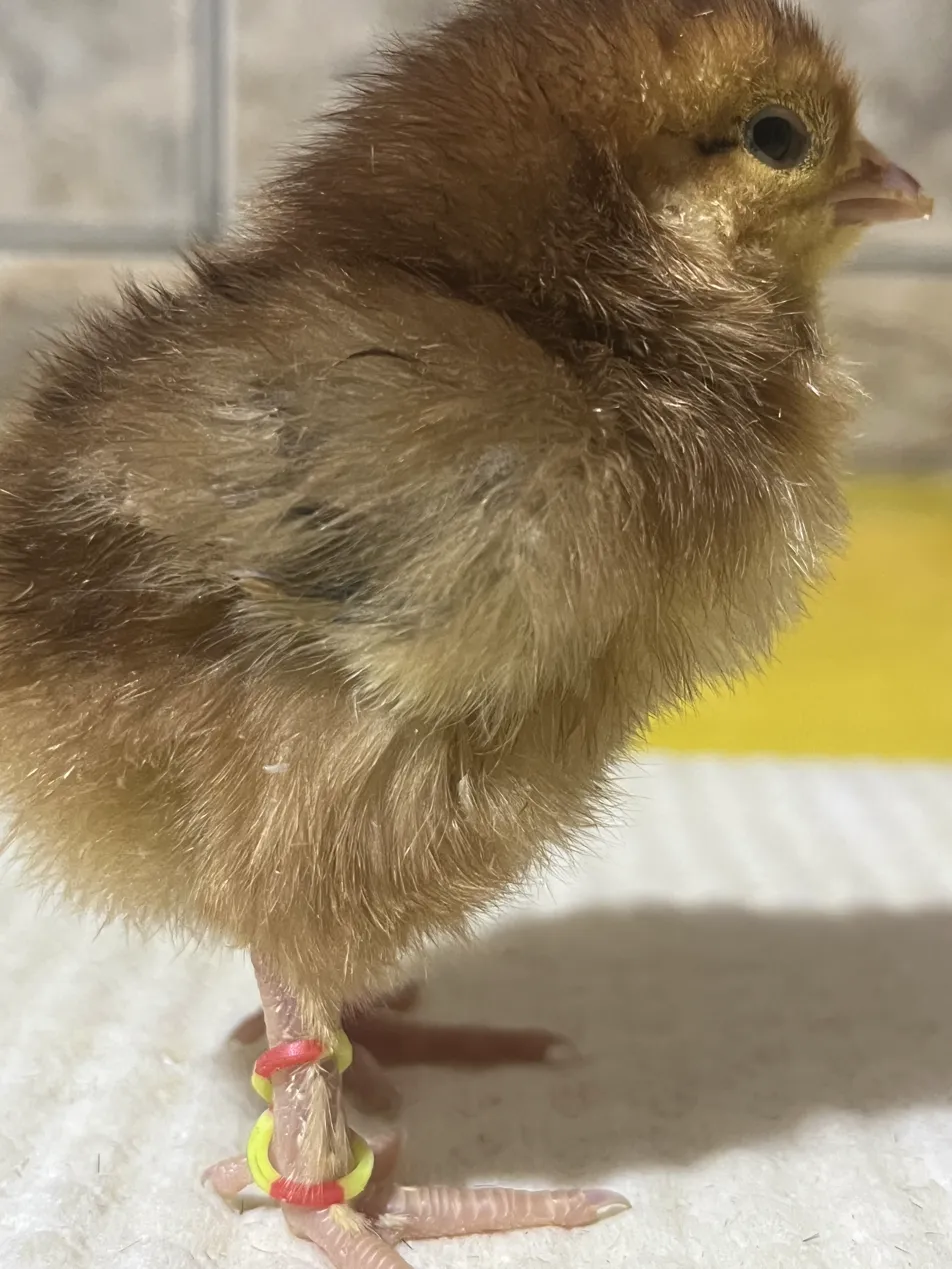
In March 2026, a batch of RIR chicks hatched at the Lab Vivo in Betim, Minas Gerais, Brazil. Of the entire batch, only 1 to 2 chicks showed feathering on the tarsi. Their parents have completely clean legs — with no visible sign of the trait.
This observation is consistent with the complex genetic architecture described for feathered-leg phenotypes. Because more than one locus can contribute to expression, the observed frequency cannot simply be interpreted using the 25% expectation of a single recessive gene.
We recorded the observation with the date, identification band, and photograph. This is the kind of documentation that turns a “surprise” in the flock into useful information for future decisions in the genetic program.
Gallora data: At the Lab Vivo, observations like this are recorded with date, individual identification, and photography. This level of documentation is what distinguishes a conventional flock from a precision genetics program.
How to manage ptilopody in your flock
1. Document before deciding. Photograph the feet, record which chick it is (leg band, marking, position in the brooder). If you know the parents, record them as well. This simple piece of data can be extremely valuable in the future.
2. Separate it from the breed-standard program. If you raise RIR for exhibition or to maintain the breed standard, be aware that the APA (American Poultry Association) classifies “stubs or feathering on shanks or toes” as a disqualification — not merely a penalty. But the chick may still be valuable for laying, productive crosses, or backyard keeping. Feathered legs themselves do not establish that the bird has a health problem, reduced egg production, or inferior meat quality.
3. Understand that “normal” siblings may be carriers. Among chicks born with clean tarsi in the same batch, some may carry relevant variants without expressing them. If you want to investigate a breeder, controlled test mating with a bird known to have produced feathered-leg offspring can provide evidence. The result depends on the genetic model and sample size, so a negative result in a small number of offspring does not prove that a bird is not a carrier.
4. If you want precision, genotyping is an option. Specialized laboratories can investigate the loci involved through DNA analysis. Testing a small number of key breeders can provide much stronger evidence than relying only on phenotype or a limited number of matings.
Feathered legs are not a disease — they are documented genetics
Feathered legs in Rhode Island Red are not a disease, an incubation defect, or a management error. They are a genetic phenotype that can persist in a population and reappear when the relevant genetic combinations come together. The practical approach is to document the trait, keep affected birds out of a breed-standard breeding program when appropriate, investigate the breeders you intend to retain, and continue selection based on evidence.
The difference between a “problem” and a “data point” is documentation. Without a record, it is simply an unexpected chick. With a record, it becomes information that can improve future decisions in your flock.
Have you observed something similar in your flock? Share it with us on Instagram @gallora.oficial — every field observation contributes to Brazilian poultry science.
This article is part of Gallora’s Open Science series, where we publish real observations from the Lab Vivo with scientific rigor and accessible language.
If you want RIR genetics with pedigree traceability from the egg onward, discover our genetic programs →
Author: Cleber Barcelos Costa — Founder, Gallora Precision Poultry Genetics. ORCID: 0009-0000-5172-9019
References:
- Dorshorst, B. J.; Ashwell, C. M.; Bhatt, R. S. (2010). Genetic mapping of the feathered leg locus in the chicken. Poultry Science, 89(7), p. 1415-1419.
- Sun, Y. et al. (2015). Regulatory mutations of TBX5 and PITX1 underlie feathered legs in the domestic chicken. Molecular Biology and Evolution, 32(1), p. 110-118.
- Somes, R. G. (1990). Mutations and Major Variants of Plumage and Skin in Chickens. In: Poultry Breeding and Genetics, R. D. Crawford (ed.), Elsevier, Chapter 8.
- APA — American Poultry Association. The American Standard of Perfection — Rhode Island Red: disqualifications.
- Roberts, V. (1997). British Poultry Standards, 5th ed. Blackwell Science.
How to cite:
COSTA, C. B. My Rhode Island Red Chick Was Born with Feathered Legs. Is It a Defect? Gallora Blog, Betim/MG, March 31, 2026. Available at: https://gallora.com.br/blog/rhode-island-red-pena-no-pe-ptilopodia